
Quick Summary:
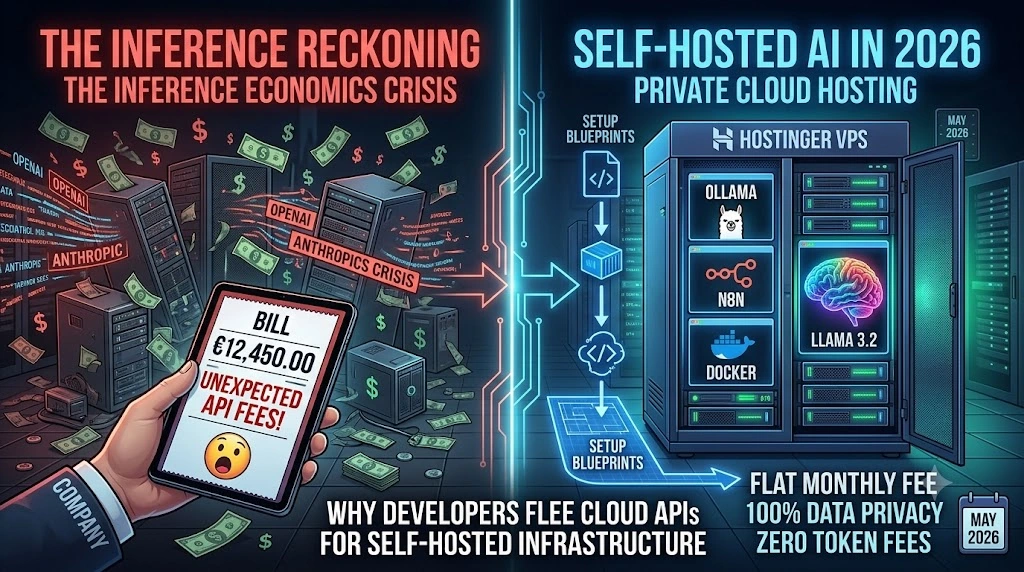
The Crisis: Production AI usage is scaling up, leaving developers with massive, unexpected monthly token bills from OpenAI and Anthropic.
The Move: Teams are migrating to open-weights models (like Llama and Mistral) for 100% data privacy and predictable, flat pricing.
The Solution: Ditching expensive local hardware to host lightweight, quantized open-source AI stacks directly on affordable cloud Virtual Private Servers (VPS).
The Stack: Running Ollama, Docker, and n8n on a standard virtual server allows you to execute infinite automation loops completely free of per-token costs.
The Hype is Over. The Bills are Real.
For the past two years, building an AI-powered application or automation workflow was simple:
generate an API key from OpenAI or Anthropic, hook it up to your code, and start shipping.
But as we hit mid-2026, the tech industry is experiencing a massive reality check.
Even though per token API costs have dropped significantly over the last 24 months, overall usage has completely exploded. Startups, data-scraping operations, and enterprise automation hubs are opening their monthly billing dashboards to find unexpected charges totaling thousands sometimes tens of thousands of dollars.
The industry has officially entered the era of Inference Economics, and the verdict is clear: running production-scale AI agents on third-party APIs is an infrastructure money pit.
The Rise of "Homegrown AI"
At major tech conferences this month, a surprising new sentiment has emerged among developers and system administrators: AI vendor fatigue.
Instead of paying a third party for every single prompt, background loop, or data extraction task, tech teams are building their own internal AI apps. Thanks to the massive maturation of open-source models like Meta’s Llama 3.2 family, Mistral, and advanced open-weights coding models, local inference is no longer a hobbyist experiment it is a production asset.
When you run open weights, the game changes completely:
Zero Token Fees: You don’t pay per word generated. Whether your AI agent runs 10 loops or 10,000 loops a day, your cost remains flat.
100% Data Privacy: Your user prompts, internal corporate documents, and database records never leave your infrastructure to train someone else’s commercial model.
No Rate Limits: You are never throttled by external server outages or sudden API policy changes mid-project.
The Practical Alternative: Private Cloud Hosting
You don’t need a million-dollar server room or an expensive local workstation with an array of NVIDIA RTX 4090s to escape the API tax.
The breakout infrastructure trend of 2026 is deploying lightweight, highly-quantized open-source models onto private cloud Virtual Private Servers (VPS). By combining cost-effective hosting platforms like Hostinger or Kamatera with modern open-source container runtimes, small teams are matching the performance of commercial APIs for a fraction of the cost.
[ Traditional Stack ] 💸 Pay-Per-Token API ──> Massive Monthly Bill
[ 2026 Native Stack ] 🛠️ Private Cloud VPS ──> Flat Monthly Hosting
By leveraging foundational open-source tools like Ollama for model serving and Open WebUI or n8n for user interaction and agentic workflow loops, you can spin up an isolated, highly secure AI ecosystem on a standard Ubuntu instance.
How to Transition Your Stack
Building a self-hosted AI application is easier than ever, but deploying it reliably is where the real engineering challenge lies. Managing container orchestration, monitoring server memory to prevent out-of-memory crashes, and routing secure external access require a concrete plan.
If you are ready to stop paying the token tax and want to start hosting your own private infrastructure, skip the trial and error. Check out our step-by-step architectural breakdown in the Setup Blueprints section, where we give you the exact Docker compose layouts to deploy your own private AI agents cleanly on your own virtual servers.